Friday, September 10, 2010

Washing Fruits and Veggies Activity

Yesterday, we took a walk to Cosentino's Market to buy some fruits and vegetables.  On the way back to school, the kids toted their purchased food in paper bags to save for lunchtime.  We had to talk about why we couldn't eat the fruits and veggies now, and that we would take them back to school to wash them before eating them to make sure they were clean.

Well, this led me to convert this creative idea from the Frugal Family Fun Blog into an activity that fit in with our Grocery Store theme and the fruit and veggies walk yesterday.

Materials needed:
Teacher scissors
Foam sheets
Washable markers
Small sponges
Water and containers, either individual or shared


I cut out fruits and veggie shapes from the foam sheets.  Then each child got a marker, fruit or veggie cut out, a sponge, and a small bowl of water.  I showed them how to make the vegetables "dirty" with the markers, and then wash them off with the sponges and bowls.

This was very exciting for them, and I think also they were just craving a sit down together activity.
Once they got started, they pretty much worked until their markers got too wet to work (once water gets on the tip, they don't color anymore, but even after warning the kids about this it was hard for them to keep the markers out of wet spots).


Those are some busy kids!  Once the water supply ran out (I was refilling their bowls from the large silver bowl) and the marker tips were spent, all but three went to find other things to do.

While others saw a project completed, they saw the potential of a big cleanup activity!  The table, at this point, was covered with water, as was most everything on the table (it's amazing we stayed dry!).
They used their sponges to wipe up the table and then we collected everything and went on our merry way.

Wow!  That was totally worth the time to cut out the shapes, and the obsolete markers, which will now be used for other activities (because I know there's still some usable color inside those things!)

Now go eat your veggies!


*Stephanie*

Wednesday, September 8, 2010

Our Pirate Theme

Here is a recap of our August theme--Pirates!

Concepts explored:
Flags (symbols are a great pre-reading skill and representational thinking gives rise to later literacy development)
Maps (spatial representation)
The ocean and its creatures
Treasure, money, exchanging goods (this is what developed into our current theme!)
Senses (visibility with the eye patch, exploring colors through work with flags and books)
Sinking and floating (pirate boats)
Manners (pirates didn't have theme!)
Identity (what it means to be a pirate, pirate families, pretend play)

In this photo, the kids took turns wearing a boat costume and holding a jolly roger flag, and with a blue marker they made waves along the extra long sheet of butcher paper.  The goal was to give them a sense of the vastness of the ocean and the long distances pirates traveled on water.


Activities:
Finding treasure
Find the Jolly Roger wet paper sack game

Eye patches
Pirate hats (twice!)

Ate lunch with our hands to display our pirate-like poor table manners
Made telescopes
Made boats that float (using corks and CD's and wood and glue)
Swords and shields
Kids brought treasures from home

Decorated small wooden boats

Treasure bags

Parrot collage

Sinking and floating activity


Some things we added to the classroom:
Pirate flags
A treasure map
Pirate puzzle
Pirate library books
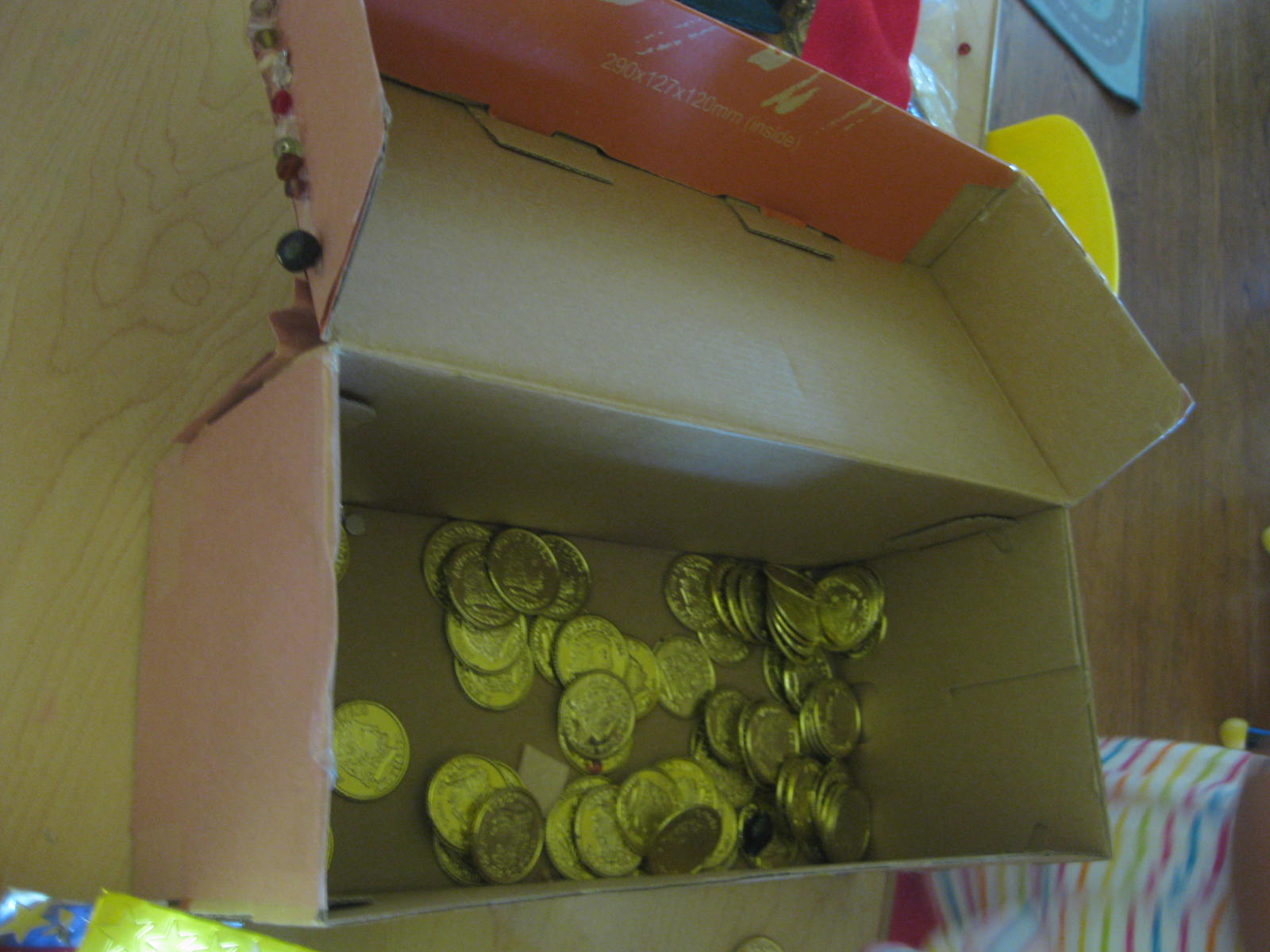
Treasure chest that the kids helped decorate
Scarves and bandanas in the dramatic play area
Sand, water, treasure and boats in the water table
Boats in the outdoor water tables


Our treasure map: Crumpled paper with a map drawn on, soaked in coffee all day, then dried!


 And don't forget our pirate party!


Pirate yoga:
Bow pose="the Boat pose"
Crow pose="Parrot pose"
Wave=moving up and down like the ocean
Half moon pose="Pirate's hook pose"
Tree pose="Pegleg pose"
Shavasana="Calm waters"


The Pirate Board Story
Once upon a time there was a pirate named Annie McGee.  Her treasure map led her to the sunken treasure at the bottom of the ocean.  One day, after many weeks of travelling, she arrived to the place that the sunken treasure sat on the ocean floor.  The problem was, the sunken treasure was under water and being guarded by dozens of stinging jellyfish!  After trying many tactics to ward off the jellyfish, Annie McGee had to call upon her mer-people friends to help her.  The mer-friends agreed to help, and as one of them played the magical harp, the mesmerized jellyfish swam in circles around the beautiful merman playing the beautiful music.  While the jellyfish were occupied, the other two mermaids brought the treasure and hoisted it up onto Annie McGee's boat.  She thanked them by sharing the treasure, and when the harp music stopped, the jellyfish swam back to the treasure site.  Seeing that it was no longer there, they swam along their merry way.  Annie McGee thanked the mer-people and sailed off into the vast blue ocean.

Resources:
http://www.fun-activities-for-kids.com/pirate-theme/
The library : )
http://www.kidscraftweekly.com/pirates2_issue.html

Using food in preschool projects

Julie and I were discussing the idea of using food in preschool art activities and the idea of wastefulness.  This is sort of a hot topic in the preschool teaching arena--most of us have an opinion about it.  There are activities that use fresh vegetables (like vegetable stamping, decorating potatoes, etc.) or dried foods (like rice or beans).  During our Grocery Store theme, we have been and are planning to use food in some of our activities.


Using a real pumpkin for Pirate Potato Head

Varying opinions range from "this is a waste of food when there are starving people in the world" to "well, you're not going to feed people with this rice, so why not use it for projects?".   A friend of mine who is from Kenya shared the other day that her cultural upbringing has influenced her stance on the matter--that one should simply not use food in a wasteful manner.  Food is for eating.  Don't take for granted that there is food on the table.  Finish what's on your plate.  Don't throw food away. 

flax seed in the sensory table
 
I have always shared the "we would not be feeding the hungry with this food anyway, so what does it matter" paradigm.  But I hadn't really considered the perception of someone raised with a scarcity of food...much of what we do could be perceived as wasteful.  It is a cultural value that I have not really considered.  As a part of a cultural majority, it takes effort to understand beyond my own perception.  Necklace-making seems like a primary use for macaroni noodles. 

Potato Prints

But what about using art materials that are eco-friendly and will biodegrade (food).  I'd rather fill the landfills (not that you're child's art will ever end up there!) with beans, rice, macaroni, or vegetables, than plastic crap like beads, pom poms, "silk" or plastic collage materials.  What will the environmental thumbprint be if I use natural versus synthetic?

Bean Soup with dried beans and glue

I invite any and all opinions on the matter.  Please post a comment...I welcome your rebuttles, too!

Tuesday, September 7, 2010

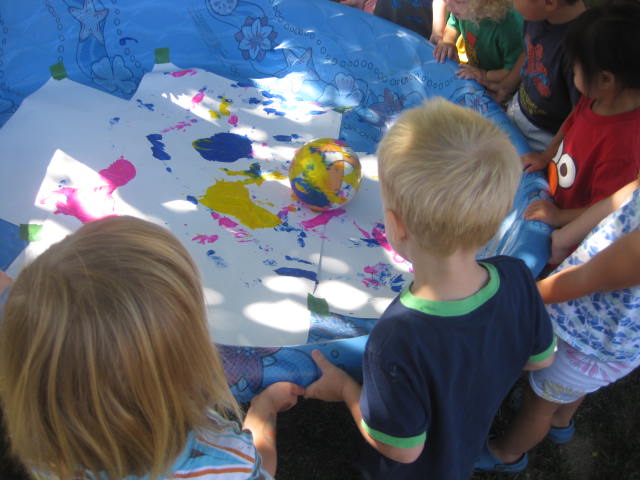
Giant Basketball Roll

Inspired by these:

Pink and Green Mama
Teacher Tom and here
Let the Children Play
Brick by Brick


we did this:

(they literally could not keep their hands out of it! )

and then it became this

and this
(they loved throwing the ball at the paper)


and soon it inspired this

Sometimes I start doing an activity with the children with the fear that it will get out of control, and I compensate by trying to control the process and the outcome.  After all these years, I'm still learning the very basic skill of letting go and following the children's lead.  This activity reminded me that the allowing children to think outside of the box (or the wading pool, in this case) can lead to a whole new dynamism in the activity.  And the bottom line is--it's more fun when they have the freedom to explore.

And thank you, Maria, for taking all these great pictures!

*Stephanie*

Friday, September 3, 2010

*social development*

I guess you could say that social development and the development of the self concept is sort of a priority in the Beansprouts curriculum.  Other things happen more easily when these are in place.

But how are we teaching them to be social?  Well, we provide protocols, like what to say if you are waiting for a turn with something ("Can I use that after you?" or "Can you give me that when you are done?").  Or what to say when you want to play with someone ("Can I play with you?" or "Which one can I use?" or "What game are you playing?").

But aside from providing some of the verbage to be used in the social environment, we really just allow the rest to unfold.

When the child is ready for social interaction, the motivating factor is social interaction. We really don't need to "teach" anything because they will try things until they figure out what works for them.

I consider my job to create the setting for development to take place.  There is a rich potential in each child for the development of every part of themselves.  I don't provide this...it is already there.  We just set the stage so that the development can reach its fullest potential.


*Stephanie*

Child-led curriculum

As you may have noticed, our new curriculum theme is The Grocery Store!  We are very excited about implementing this theme and have brainstormed lots of activities and concepts that can be included into this theme.  Leslie really brought the theme to life on Wednesday with her Grocery Hunt (she hid pictures of food in the backyard and the kids went and found them) and the Favorite Food project in the Bean Patch (a collage in which the kids loaded their printed shopping carts with images of their favorite foods).

Why did we choose this theme?  Well, after visiting Barron Park Preschool a couple of weeks ago, we noticed all of the real food on their dramatic play shelves (real canned food, empty containers, even dried out bagels and a whole coconut!).  So we implemented the idea here.

Then one day the children started "buying" food with the pirate's treasures in the classroom.  They had so much fun with that (and imagine all of the learning opportunities going on there) that we added small re-usable shopping bags to the dramatic play area.  Well, it took off from there.


And here we are, the beginning of our grocery store theme!

And we're looking forward to our field trip to Cosentino's Market next week!

*Steph*

Wrestling is good for children.

Originally published Sept 2010 Many of our parents seemed shocked when they came to pick up their children from Beansprouts and found the...