Showing posts with label reflections. Show all posts

Tuesday, November 1, 2016

What we leave behind - a reflection on Dia de los Muertos


On this Day of the Dead, I'm contemplating what we leave behind. In the context of working with children, I'm thinking about the memories and impressions I leave with the children that I interact with each day.

When I was a child, I went to preschool. We were not a family that could afford preschool every day, so I think I only went one or two days per week. And I remember very little about it. In fact, I have only two memories. One is being told that circletime has begun and I needed to come out of the play kitchen.  My memory is not of the words, but of the feeling that I had gotten in trouble. Guilt. The other memory is of me crying at the door. Or maybe I was seeing someone else cry and taking on the emotions around it. It's foggy.

I remember small snippets of my childhood, brief interactions and the way I felt during those moments.

When I interact with children, I often reflect on what memory I will leave with them. What if this is that one memory that they carry away from preschool? What if this moment is my one chance to leave their lifelong impression of their first teacher?  What if they don't remember my words, but remember instead the feeling that our interaction invoked within them?

Today's post, this post after years of absence from this blog, is a question...a reflection. Not a statement, nor an answer.

What can I do to take each moment as an opportunity to leave behind a legacy worth remembering?


Tuesday, July 2, 2013

Not Just Playing

In the realm of early childhood education, we are very aware of the fact that in quality preschool programs, children are "not just playing".  We bring so much intentionality into everything we do and every activity we offer, taking into account children's interests, levels of development, and developmental goals for each child.  


Free play is offered to children in abundance at Beansprouts Preschool. However, free play is observed and guided appropriately when children are unfocused or seem to need more grounding.  A high level of awareness is necessary to assess where the children are on any particular day, and what they need from us.  It is only on my very worse days as a teacher that I am just "getting through the day", meaning the activities aren't happening but they just aren't presented with the usual level of intentionality behind them. Most of the time, we plan specific activities, areas of the classroom, new works, and new games for the children with specific developmental goals in mind.  Sometimes, this is intuitive. Sometimes we plan it out weeks ahead of time.  Some days, the best thing for the children is to allow them to fully direct their own play. On other days, more teacher facilitation is needed. To the untrained eye, all of these approaches could look exactly the same. However, we work hard to implement a program that is "right" for each child.  So while it looks like the children are "just playing", they are playing in an environment that we have set up with utmost care.

***

In this photo, K and C are using boats in a muddy river made by Sh.  Just playing? No way! This is a two-year-old and a four-year-old completely engaged in give-and-take of truly cooperative play.  The dialogue was rich with inquiry, as they checked in with one another to ensure they were both aligned with their self-created rules. Not to mention that they are playing in a river that Sh spent an hour digging and directing.


In the next photo, K is putting on dress-up clothes.  In the safety of a costume, children get to take on other roles (which has much significance in their cognitive development), explore different parts of themselves, and interact in new and highly flexible ways with others. In pretend play, anything is possible!


If the significance of this activity seems obvious, well it is. Puzzles offer multi-level brain development. But the most important part of this activity was the teamwork involved in putting the puzzle together!  


We make our own board games with our own goals in mind. For instance, in this board game, the sea creatures are trying to make it to the birthday party at the end of the game.  But it takes more than one to have a party, so they wait for their friends to arrive at the birthday party before ending the game! This encourages team-playership and a sense of camaraderie.  


Loose parts like these pool noodles are important in allowing us to tap into the world of the child. When they have loose parts to play with (blocks, sticks, rocks) that are completely open-ended, we get to see where their minds and hearts take them. We really get to know the children by observing their open-ended play.


Structured activities like this tracing and numeral matching work are offered as children begin to show interest and readiness in fine motor and academic learning. Because we work with a mixed age group, we don't impose a "way" to do this, but offer an option and allow them to use it in whatever way they are ready.


 Sensory tables tap into parts of the brain that other activities simply cannot. The way children gravitate toward sand, water, and mud ensures us that these sensory materials fulfill something vital for them.


They aren't just playing, and we aren't just watching.  There is a whole symbiotic, synergistic flow at work that allows the children to teach us exactly what we need to teach them.  As one of my mentors used to say, everything we need to know is right in front of us. We just need to look to the child and listen for the answers.

Thursday, September 13, 2012

Thrifty Thursday: Duct Tape

I told the children that I would take off the broken basket on our very old, second hand scooter. It was already past its prime when it landed in our play yard. Yet we find it a beloved vehicle and can't seem to throw it away.

The children suggested we tape the basket instead of throwing it away. I guess I'm rubbing off on them.

The application of duct tape is equivalent to buying a new one, as far as we're concerned.

The thing is, during the "fixing" process, all they cared about was holding the tape for me.  Preschoolers are so unpredictably predictable in this way. It's not about the fixing, it's about the process. And in this case, there was one micro-component of the situation that received the ubiquitous attention of every child involved--"when is it my turn to hold the tape".

It's moment like these that we get to introduce (and practice) basic, yet very meaningful, social skills.  How to ask for a turn, how to get a turn, how to share, how to not share, when to wait, when to speak up.  

We also just spent a few minutes together, with a common purpose, a common interest.  A community of friends and learners.  Lovers of duct tape.


Wednesday, March 14, 2012

Models and expectations


Last week, I introduced a tray of sorted color strips for the children, and I showed them how to make 3 dimensional rainbows.  There were a ton, but here is a small sampling. Interesting how different they can turn out!


Definitely not like my model, which told me how creative and 'outside-the-box' thinkers they are!!!

 Well with all of those paper strips, I had lots left over.  So I thought I'd show the children how to make paper chains.  I thought that since we've been exploring the idea of rainbows and colors, the paper chain would make a beautiful garland around the classroom.   You know, a long colorful chain, where we all connect our chains to those of others.


Yeah, right. That's not how it went at all.

Nobody wanted to connect their chain to anybody else's, and they all wanted to decide where to hang their own up in the classroom.

Imagine how frustrating it would be for the teacher and the children if I had enforced my model about how this activity "should" go.  The children were learning a new skill, so focusing on color arrangement and even looping two circles together took a lot of cognitive and fine motor control.  Creating the chains based on my model was totally out of the question.

I had a model, but the kids had their process.
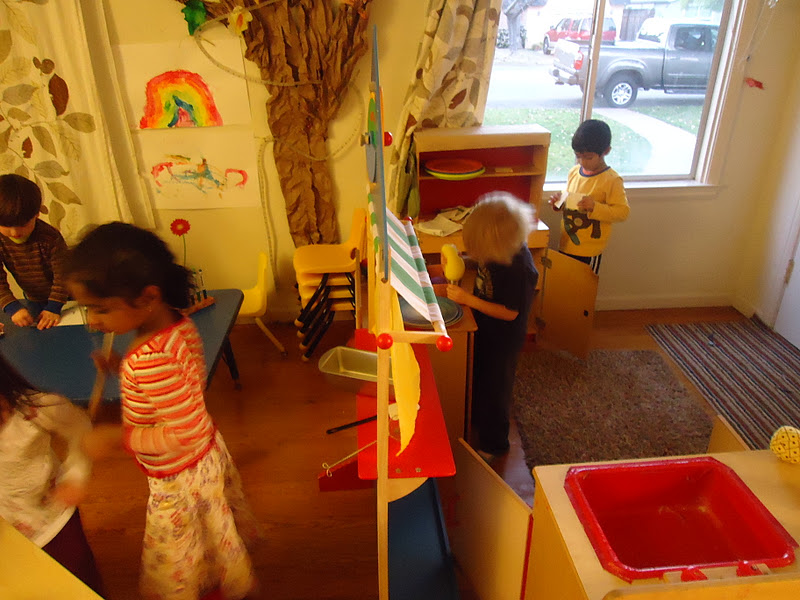
And once they realized they could make me "faint" because of how beautiful they were making the classroom, then the fun began.

What makes these children happy? Making Stephanie faint!!!


I was too busy fainting to take photos of what was happening, but I told the kids very firmly that they can't hang up their paper chains because it might make the classroom so beautiful that I would faint!!!

But of course they did it anyway.


They had so much fun making me faint and then waking me up that we ended up with paper chains all over the place!


The classroom is theirs. They chose where to put the decorations and how long to make them.  The most important thing is that they had fun. This would have been a very unlikely outcome if I had made this activity go my way!


And, better than my expectations, our Rainbow Tree is also quite lovely these days.


Thursday, March 1, 2012

Dr. Seuss Day: A scavenger hunt and my thoughts on hollywoodization

A Scavenger Hunt that corresponds to One fish, two fish, red fish, blue fish. 
As we read the story, children can circle or cross out 
the pictures they see in the story.
We're doing it BINGO style!
I write this post with just a little uncertainty about how it will be taken.

I hope you can see my point, even if you don't agree.

My courage to click the "Publish Post" button comes from this quote, often referenced to Dr. Seuss though its origin is up for debate:

Be who YOU are
and say what YOU feel
because those who mind don't matter
and those who matter don't mind.

Last week, the teachers and I decided to celebrate Dr. Seuss' birthday.  The day after I sent out an announcement about our celebration, I saw a commercial on television for the upcoming movie, "The Lorax".  A dark cloud drifted over me and my husband asked "What's wrong?".


I tried to explain to him why I will never be able to read The Lorax to another group of children without them all calling out "I've seen that movie!".  They will arrive at story time with preconceived notions about the the story and characters.  They will fixate on the characters rather than the message. Why? Because the movie business has spent millions of dollars researching how to sell products to children through movie and television characters.  Not even to mention how corporate sponsors will capitalize on this children's movie.  Can we not keep corporate greed out of a movie based on a book whose target audience is young children????

Those teeth! I love those teeth! 
I still remember the first time that I read this book. 
When I got to this page I laughed out loud!!!
Ah, great memories of Dr. Seuss books. 
They are something worth celebrating!


I felt the same way when Where The Wild Things Are came out in a movie. I haven't seen the movie and I'm sure it's great. However, I haven't been able to bring myself to read the book to the children for the same reason I don't like reading books about other heavily commercialized characters.


I was so impressed with my ability to copy Dr. Seuss' art.

I'm sad that for money and without even an iota of concern for what will benefit children, commercialism has begun the consumption of the great Dr. Seuss.  Teacher Tom offers some great insight on the topic as well.  Tomorrow we will celebrate the legacy that is Dr. Seuss and all of the pure and good that comes from his works.  But I had to share my sadness about the possible loss of The Lorax from the Beansprouts curriculum henceforth.  And I can't help thinking that by celebrating Dr. Seuss' birthday, I am somehow helping to build it into a great big holiday where all of the CVS and Toys R'Us chains start stocking their shelves with crap for us to buy, as everyone tries to capitalize on this new "holiday".

~~~
I promise, PROMISE, that my next post will be a HAPPY one!!!
~~~

You have brains in your head
You have feet in your shoes.
You can steer yourself
any direction you choose.
You're on your own
And you know what you know.
And YOU are the one who'll decide where to go...
-Dr. Seuss
from Oh! The Places You'll Go!


If you're feeling how I'm feeling, scoot on over to The Campaign for a Commercial-Free Childhood and help take a stand against hijaking The Lorax movie for commercial gain.  

*Stephanie*

Monday, January 16, 2012

How we talked about freedom


On Friday, I wanted to  have a discussion with the children about Martin Luther King, Jr., but I had no idea where to begin.  Luckily, I did get a lot of inspiration from this blog post from Preschool Daze.

There was one little hiccup, though.  WHY did I have to mention that fact that he is no longer alive? These children, who explore death through superhero play, family games, questions about science and nature and animals and bugs, maybe didn't need that information.  Because that was what they fixated on for most of the discussion. "Why isn't he alive anymore?" "What dead-ed him?" "Is it because he was old?" I have to admit I have never been this stumped as a preschool teacher. I'm the one with the answers...but how on earth do I explain that???  I have yet to figure out what to tell them, so I will be curious to hear their conclusions from talking to their parents over the weekend!

Once we could steer the conversation back into my direction, I decided to focus on the aspect of Freedom.  What is freedom? In the simplest terms, its our ability to choose, and our children know all about that. We use choices as an integral part of our discipline and guidance protocol over here.  They were able to identify with the ability to choose and also the events where others try to make choices for us.  It was unanimous that we like to make our own choices.

It was interesting to talk to the children about this celebration. I had to set the context for what life was like. And the bottom line was, back then, some people got to make choices for other people who had different skin colors.

Children notice and use differences in how they define the world. It is an inherent part of the human mind to do so. As I explored in this post, we can't leave racial attitudes in the hands of media, society, or the assumption of good-heartedness. Historically, this has never worked. It's my job as a preschool teacher to bring the topic of race to the forefront of the discussion. This is how children will be able to overcome the natural tendency to categorize and rank by physical attributes.

So we talked about how today, because of men like Dr. King (who, we said, is like a superhero!), we get to trust that we will be safe and that there are rules that make sure that everyone is safe and that everyone gets to make their own choices.  While this is not 100% true, in the secure world I want to create for the children, we will simplify it in this way.  And I think that some day, maybe not at preschool, but some day, parents can talk to their children about the injustices that are happening right now in other parts of the world. And maybe some day, these little ones will grow up to be the next superhero!


I'm so grateful for those who walked before me and paved the way so that I could live a better life today.

May we all have the courage to speak our hearts and speak our truth and make a difference.

*Stephanie*

Monday, January 9, 2012

They worked it all out

S's family (the new 'S') donated a lemonade stand to the preschool today.  The children saw it on the porch and immediately asked to bring it into the classroom.  Being the experienced preschool teacher that I am, I knew that introducing it to the room while there were only six children (the other six had gone home already) was better than introducing it when there will be twelve children tomorrow.  Why? Well, I explored the idea in yesterday's post : ) Children like novelty, and they like things that there are only one of.


Well, the introduction of the lemonade stand created a pandemonium of sorts with our remaining six children. Chaos, noise, everyone wanting turns to sell the lemonade, adjust the adjustable wooden clock on top, open and close the curtains.  Lots of strong little wills bouncing about. 

But these children have the skills to work out these situations (again, read yesterday's post), and they just had two weeks off for holiday break during which these skills had time to assimilate into their neural networks.  And this situation proved to me that the information moved through the hippocampus from short- to long-term memory.  We need rest to learn, and that's what vacations are all about! Proccccesssssingggg....

So I watched and waited to see when I would be called upon to intervene.  I would surely need to help settle a conflict.  That, my friends, was not the case at all.  Within a matter of minutes, they had worked out who was making, selling, and distributing lemonade. We had a guy in charge of making and hanging signs.  We had someone else in charge of making lemon cookies (because you can't have lemonade without lemon cookies). And, of course, we had the person in charge of putting salt and pepper in the lemonade because this is an integral part of the lemonade-making process.

I loved that I could just step back and observe years of coaching through social situations pay off.  A friend of mine was just telling me how hard it is to work on a small team of three people at his company. The conflicting ideas and resulting delaying of deadlines proves to me how very important these social-learning contexts are for children.  It's practice. But I don't want to undermine the significance of their play by making it an issue of "school readiness".  Today is just as important as elementary school or adulthood or any other phase of life deemed more "meaningful".  This is it, and today is all we have.  I think the gift is that these children got to leave school today with the experience of working on a cohesive and harmonious team of co-leaders.  What a gift.


I posted this on:

Everyday Dramatic Play

Saturday, October 29, 2011

Broken Bricks


When I was around seven or so years old, we lived next door to two brothers, Tommy and David, who were the same age as my sister and I.  We played together--a lot--and there was a lot to do.  Hide-and-seek is the most memorable sport we played, along with trying to throw things on the roof.

I remember one day when the whole family was at our neighbor's house for a BBQ.  The adults were inside and I was goofing off outside with the kids. One of the boys showed me a hammer and how he could break a brick with the hammer.  Their shrubs were surrounded by a brick border.  It looked like good fun and, well, no red flags went off in my head about how inappropriate it would be to break all of their bricks.

And that's exactly what I did. I just hit one brick after another with the hammer until the game was over (ie. no brick left unhammered).  The boy disappeared, probably because he knew this was not a crime for which he wanted to be an accessory.

The thing is, I thought nothing of breaking the bricks. It was entirely an explorative process.  Yes, I was old enough to use common sense, but I guess you can say that my common sense was a late bloomer.  I didn't even realize I had done anything wrong until I saw the expression on the adults' faces when they saw what I had done.

I was acting on a very non-cognitive impulse.  I was seizing a new experience. I was following what felt like a natural sequence of events. There was a hammer available.  There I was. Hammer, bricks.  What was a girl to do?

I try to keep this experience in mind when I see children doing things that they "should" know is not okay, yet they do it anyway.  More often than not, they are just using a hammer to make broken bricks.

Saturday, October 8, 2011

Getting organized


I spent one hour (just one!) making an organization system for our classroom.  I tend to have my own little notes (er, in my head) about things I want to do with the kids, and occasionally we have a weekly plan that corresponds to the curriculum theme.


And although I tend to thrive in an environment that allows for spontaneous inspiration, I do have those days when inspiration doesn't come and I need a plan.  And when I have a plan on a day when inspiration does come, I can use that inspiration for other things, like how to upgrade the environment, or what to add to the sensory table, or what new station to set up in the classroom.


We have a schedule of who is in charge of what and which days so I put that in the binder, plus some extra weekly planning sheets.  


I like to save stuff, so I made a place to save our old curriculum plans. Hey, why reinvent the wheel next time we do the theme? At least we have some skeletal components for the theme next year.


Since we've been doing printed daily logs of our activities, we can save those for reference, too. 


Now that the system is in place, it will be much easier to follow it.

(Fingers crossed!)

Friday, September 30, 2011

This is a story about a book

The library can be very overwhelming for someone like me.  

So many choices! So many authors! So many subjects!

I usually take one or two sections and thumb through for the books that jump out at me.  I might, on my way to check out, stop by a favorite author, or look up a favorite title.  

This week, I was thumbing through a section of books, I came across this one:


I thumbed through it and saw that it was a story about a wolf who keeps trying to sneak up on a pig to eat him, but the pig, by no effort of his own and completely unaware of the wolf, slips by unharmed in each situation.  At once I put the book back. "They already play too many games based on Abiyoyo, Jack and the Beanstalk, and big mean bears. They don't need another book with the antagonistic bad guy!".

Then I took it back off of the shelf and into my heaping pile of books to check out.

Isn't that exactly the reason I should check that book out? What if--what if--they like this book more than any other in the batch? What if the element of risk and fear that is driving their imaginary play is exactly what they need right now? What if I just listen to the children's cues and go with it, rather than trying to resist the recent "bad guy" theme of their play?  What if I put this book back on the shelf and lose the opportunity to find my next favorite children's book?


Well, I put a dozen library books on the bookshelf this morning and guess which one was THE most popular book?  Suddenly!!!! The problem solving and figuring out of the plot that is required to really comprehend this book is at the perfect level for the four-year-olds in my group.  Plus, this book plays on their latest enactments of the three little pigs, which have driven countless team work and problem solving situations in the classroom.  I really couldn't have asked for a better book in our classroom this week.

Oh, and you should have heard the conversations that they had about this book.  Small groups of children would huddle around it, talking about each page.  It was beautiful.

They enjoyed it.  I enjoyed it.  'Nuff said!

Wrestling is good for children.

Originally published Sept 2010 Many of our parents seemed shocked when they came to pick up their children from Beansprouts and found the...