Originally published Sept 2010
Many of our parents seemed shocked when they came to pick up their children from Beansprouts and found them all wrestling on a mat in the middle of the yard. No one questioned it, so I'm assuming they trust our judgment that much : )
One of my favorite preschool blogs, who I have probably linked to in the past, is Teacher Tom. He discusses wrestling in the following posts:
Why We Wrestle
They Went Home Tired
Wrestling 2010
And he also refers to this link, which is also nice.
Before:
Hugging=squeezing and falling
During:
the point was to help kids take cues from others, make contact with one another in a way that was rough but still fun, hard to take cues when too many kids and three-four at a time worked really well. we split the group up into the blue group and the rainbow group (that was also a great way to solidify their recognition of their own group) we also split it up boys and girls. six seemed to become the tipping point. plus they got to work on starting and stopping (took practice) because as we switched groups, the previous group would have to get off and this took practice for all of them. It seemed that when they were in smaller groups, they self-regulated whether they wanted "wrestling" or "tumbling", as teacher tom differentiates in his post. Often there was a flow, as the children alternated between wrestling and tumbling.
Also we did have to
make sure it was "fun" for everyone. When it looked to the teacher that it wasn't "fun", we would ask and modify if needed. And certain ground rules are in place. hitting and kicking and clothes pulling are not allowed for obvious reasons. one of the children started using the word "punch" and we make it very clear that we're not going to let that child punch at preschool. It's been interesting to watch the children make their own interpretations of wrestling, and for some, it's mimicking what they've seen on tv (fighting) and the teachers are always there to make sure that the children understand that it's not fighting, it's just a game, and those children get to re-define their own scripts about physical contact (competing with mass media messages is one of the biggest challenges of a teacher, so if they come away with a new definition of rough physical contact with others, then we've done our job here)
sometimes we just held an ice pack waiting for the first injury, but whenever a child got injured, they inevitably held the ice on their injury for just a moment, and then returned to the game. I loved that they were willing to take a risk to participate in a group activity and connect with their peers.
Every now and then we'll get two or three crying kids at once. It happens about every other wrestling session, not every time. And each time I wonder if maybe we're giving them two much freedom, but seeing how willing the hurt children are to resume the activity, I'm reminded that preschool fun (and learning) has inherent risks. Everything they do has risks. Doesn't mean we keep them in a bubble.
After:
They've sort of lost interest in wrestling. They've transitioned into a new physical contact bonding ... the cat game. They all pretend like they are cats, each a member of the cat family, and identify themselves according to their moods or other internal attributes like the "angry" cat or the "grumpy" can or the "bad" kitty or the "tired" kitty. Considering that family dramatic play is new, this is a significant leap in their social and cognitive experience at school. They paw at each other, lick each other (we encourage them to "pretend" so we don't spread germs), push each other around for space on the cat beds (old couch cushions that we have in the yard). Sometimes three children participate, sometimes it's almost the entire group. It's wonderful.
It's also been great for those children whse social skills are still raw, the social interest just showing up and still resorting to younger-two strategies to enter into play with other children. For a few of these children, strategies for engaging other children were hitting, grabbing, pushing, hugging to hard, taking the child's toys, and other inappropriate ways of getting attention. Wrestling sort of "assigned" rough physical contact to the game of wrestling, making it sort of ridiculous to use it in other contexts. Some bonding occurred as well.
A lot of what they learn is how to engage in physical play safely, they learn awareness of who is in their space, how much is "too" much.
Beckett's breakthroughs
Showing posts with label social. Show all posts
Showing posts with label social. Show all posts
Thursday, March 24, 2022


Tuesday, July 17, 2018
Space to Feel

Children's responses to "would you like to share your feelings today?"
This list of feelings emerged in our circle time conversation today. I would like to share the complexity of feelings that emerge in our group time. It was a very honest and organic conversation.
Some days, I plan our circle time. Other days, I am spontaneous. Most days, the kids let me know what we're doing, whether verbally or just showing me that they aren't interested in my plan. Circle time is pretty flexible. We're always ready to change the course.
On this particular day, we would be singing songs. Before circle time started, I noticed a little wooden toy on the floor. I asked the child sitting next to me to put it away. When she returned to circle after putting away the toy, her seat had been taken by another child. I waited to see what she would do and she seemed content to sit in another spot. Normally i would save that spot since she was doing a job, but she didn't seem bothered in the moment and didn't ask for her seat back.
However, as circle time progressed, I noticed she had a sour facial expression and didn't seem too thrilled when it was her turn during the good morning song.
When that song was over, I announced to the group that I noticed some feelings at our circle time and asked if anyone would like to share their feelings.
I reminded them about a story from the day before - a story where a grumpy joey (baby kangaroo) who woke up feeling grumpy. It's a very sweet story, where the mama kangaroo tries to cheer up the joey. However, what I honed in on in this story was the mother kangaroo's persistence in cheering up her baby. When one strategy didn't work, she would move on to the next - hugs, distraction, jokes, games.
We talked about the idea of cheering someone up versus trying to change their feelings when they don't want help. We talked about ways to ask for help, for instance asking for a hug or asking to be cheered up. Sometimes we just want to feel our feelings, which is a trend that I've observed with this group of children. That's not to say they are unique in this way -- perhaps I have not tuned in to this with prior groups.
The same day, a child at story time didn't like the way I corrected her behavior, and she was quiet with folded arms (something I'd describe as "pouting"). I felt uncomfortable by her sadness and wanted to comfort her. Moreover, I wanted to control how she perceived me in my teaching efforts. I offered her a hug. She declined. I let her have the space to feel the emotion and she recovered quickly. But I SO BADLY wanted to "fix" her feeling.
A couple of guiding principles of my teaching philosophy are:
1. no one is in charge of anyone else's feelings
and
2. feelings, positive or negative, are okay and normal parts of our life.
We welcome and talk about feelings A LOT. Not in a way that creates a sense of victimhood and "poor me". We talk about feelings in a matter of fact way. It's okay to have them, feel them, not have them (because sometimes I really want kids to feel the "positive" feelings!).
I let the children know that when they share their feelings at circle time, I won't try to change the way they feel. They get to have whatever feeling they want. Feelings are welcome in our safe space. This seemed to allow them to get more vulnerable and share the darker feelings (as you might notice on the feelings list in the photo).
Each child went around the circle and each person was offered time to share their feelings. If they chose to share, they were asked if they'd like to elaborate. I wrote the feelings down (and made little faces to depict the feeling so the children could "read" the feeling). I wanted the feelings to be visible, reflected on this paper where we could see it, have a little more sense of perspective around it, let it be a word and not this whole nebulous overwhelming experience. I wanted to validate the experience while allowing the children to feel bigger and empowered over their feelings.
After all, we are not the way we feel. We are not the feeling. Feelings aren't facts. They feel like facts. But they are fleeting experiences. And when we know this, we can offer coping skills and ways to reframe their experiences when the experience is overpowering. We are building emotional literacy, so we can be members of the community who feel compassion and sorrow and excitement and hope, without acting irrationally and impulsively based on a fleeting emotion.
The child whose space was taken at circle time - perhaps she needed time. Perhaps she wanted to explore the feeling and just sit with it like a friend for a minute. Maybe she needed words to label the feeling and thereby understand it.
My most important role is to create the space, hold the space, allow the space, and be there for when (or if) the child needs my more direct support.
---
For more from me, visit www.todayatpreschool.com
Thursday, September 13, 2012
Thrifty Thursday: Duct Tape
I told the children that I would take off the broken basket on our very old, second hand scooter. It was already past its prime when it landed in our play yard. Yet we find it a beloved vehicle and can't seem to throw it away.
The children suggested we tape the basket instead of throwing it away. I guess I'm rubbing off on them.
The application of duct tape is equivalent to buying a new one, as far as we're concerned.
The thing is, during the "fixing" process, all they cared about was holding the tape for me. Preschoolers are so unpredictably predictable in this way. It's not about the fixing, it's about the process. And in this case, there was one micro-component of the situation that received the ubiquitous attention of every child involved--"when is it my turn to hold the tape".
It's moment like these that we get to introduce (and practice) basic, yet very meaningful, social skills. How to ask for a turn, how to get a turn, how to share, how to not share, when to wait, when to speak up.
We also just spent a few minutes together, with a common purpose, a common interest. A community of friends and learners. Lovers of duct tape.


Monday, June 4, 2012
Consensus Problem Solving
First of all let me tell you about my latest hobby: Yard Sale-ing! I have found some great treasures for pennies. Here is one of my latest scores. It is a building set using pool noodles with magnetic connectors and pieces of fabric that clip on to make partitions. I got it for a whopping $3 at a yard sale.

It is however only one set. The typical preschool classroom requires at least equivalent to two sets of things to maintain harmony. Once there is an insufficient amount of material to work with, children start getting a little, er, grabby and argumentative.
In any case, the scarcity issue has been a great opportunity to practice working together, problem solving and thinking outside the box. (There's always a silver lining, right?)

Working together, listening to and sharing ideas, and employing the use of other sets of learning materials all led to independently solved problems.

Of course, there was the occasional disagreement that required teacher intervention. In my ECE classes, I have heard this protocol that has always guided the way I help children solve conflict:
1. Listen as each child identifies the problem
2. Ask if either child has an idea about what to do next
3. Use their ideas to propose a solution
4. If no solution can be reached between the children, offer a solution for them.
Well, one day after visiting my friend Liat's preschool program, I saw a wonderful new way to modify the last two steps. At the end of each conflict negotiation, she would ask each child if the proposed solution was okay with them. She didn't offer ideas, and she didn't impose judgment. She simply allowed the children their process and made sure there was consensus among them before proceeding.
It's a subtle difference, but brought about a huge change in the way I manage conflicts in my program. By not imposing a last resort strategy (step 4 in the above sequence), I am forcing myself to step back and allow the children to take 100% responsibility in their own conflict. I am the facilitator of discussion rather than the final decision maker.

Sometimes, the children simply get tired of talking and will give in or walk away. But who is to say that this also not useful for them? Learning to compromise is a great way to practice coping when things don't go our way.
Sometimes, the outcome will not be what I consider to be "fair", but since both parties are okay with it, my opinion is irrelevant.

Usually, children come up with a solution beyond what I would have imposed. And the older they get, the more creative they are with how they manage their own conflicts. Although I expect this now, I am still taken by surprise to hear how they use outside-the-box thinking to manifest solutions.
Further, by requiring consensus, the children are given a last little nudge to meet in the middle. When I was resorting to the enforcement of a "fair" solution, I robbed children of that last little piece of the resolution process--that which offers a true learning experience. And, of course, I was robbing them of the opportunity to take ownership of their own process.

I am fortunate to have been exposed to a more consensus style of conflict resolution. It has opened up areas in my teaching that have benefitted both me and the children. My mentors are everywhere when I stay open-minded and receptive. I've been doing this teaching thing for over a decade now, yet I have so much to learn.
 |
| Bl enjoys being able to go inside the structure that they have worked hard to build, and fine tunes its construction from inside. |
Have a good week!
*Stephanie*
Tuesday, March 27, 2012
When friendships are more precious than gold

The first time I saw children hunting for gold (spray painted pebbles) that leprechauns (teachers) had hidden in the yard, I remember commenting to my co-worker, "Wow, it's really like the gold rush! They've all got gold fever!" and we laughed--because it was so accurate! Every year, we would watch gold fever unfold, where children frantically looked for as much gold as they could get their mitts on, having complete meltdowns when they spilled their gold, and feverishly looked for anything shiny, hoping on all hope that it was another piece of gold.

I thought this behavior was just a given. I thought it spoke to human nature, and that we all just have this inherent greed that is only overcome by tireless hours of self reflection and growth.
This year, the children showed me how easy it is to be selfless.

Rather than having millions of little golden pebbles, the "leprechauns" only hid two dozen large pieces of gold. We only have twelve children in our school on a given day.
I told the children that when I was out in the yard, I found a piece of gold (I pulled it from my pocket to show them). I told them that I thought I saw some more, but only a few pieces. Could the kids find them and also make sure everyone had some before filling their bags? They all agreed.
They put on their shoes and jackets and went outside. It was a beautiful process that unfolded.

Children were as concerned, if not more, in helping others find gold than they were for finding gold themselves. When they found a spot with many pieces of gold, they'd call their friends over to see and partake. They had conversations, gave suggestions where to look, talked to each other about who had not found any gold yet. Their excitement to show others what they had found supplanted their need for "more". Above all it was downright heartwarming to see children ensuring that everybody's needs were being met.


It's nice to see that as they have gotten older, the community spirit has gotten brighter at Beansprouts.
Further, I would like these children to talk to our politicians and teach them a thing or two!
Monday, January 9, 2012
They worked it all out
S's family (the new 'S') donated a lemonade stand to the preschool today. The children saw it on the porch and immediately asked to bring it into the classroom. Being the experienced preschool teacher that I am, I knew that introducing it to the room while there were only six children (the other six had gone home already) was better than introducing it when there will be twelve children tomorrow. Why? Well, I explored the idea in yesterday's post : ) Children like novelty, and they like things that there are only one of.


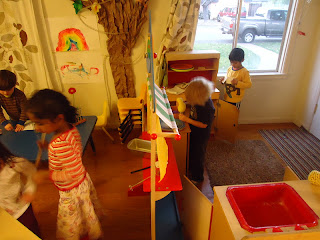


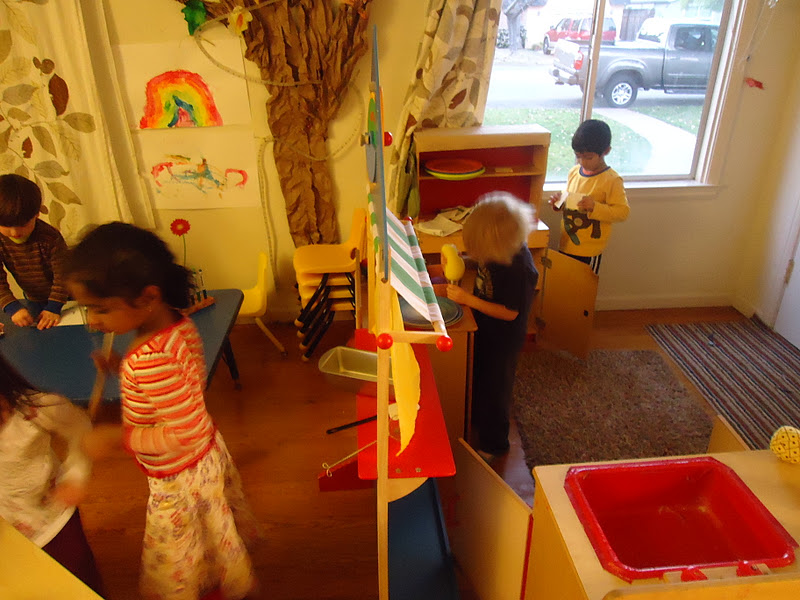
Well, the introduction of the lemonade stand created a pandemonium of sorts with our remaining six children. Chaos, noise, everyone wanting turns to sell the lemonade, adjust the adjustable wooden clock on top, open and close the curtains. Lots of strong little wills bouncing about.
But these children have the skills to work out these situations (again, read yesterday's post), and they just had two weeks off for holiday break during which these skills had time to assimilate into their neural networks. And this situation proved to me that the information moved through the hippocampus from short- to long-term memory. We need rest to learn, and that's what vacations are all about! Proccccesssssingggg....
So I watched and waited to see when I would be called upon to intervene. I would surely need to help settle a conflict. That, my friends, was not the case at all. Within a matter of minutes, they had worked out who was making, selling, and distributing lemonade. We had a guy in charge of making and hanging signs. We had someone else in charge of making lemon cookies (because you can't have lemonade without lemon cookies). And, of course, we had the person in charge of putting salt and pepper in the lemonade because this is an integral part of the lemonade-making process.
I loved that I could just step back and observe years of coaching through social situations pay off. A friend of mine was just telling me how hard it is to work on a small team of three people at his company. The conflicting ideas and resulting delaying of deadlines proves to me how very important these social-learning contexts are for children. It's practice. But I don't want to undermine the significance of their play by making it an issue of "school readiness". Today is just as important as elementary school or adulthood or any other phase of life deemed more "meaningful". This is it, and today is all we have. I think the gift is that these children got to leave school today with the experience of working on a cohesive and harmonious team of co-leaders. What a gift.




I posted this on:
Sunday, January 8, 2012
Foil collage
Inspired by Teaching 2 and 3 Year Olds, we used foil and sequins to make our own "shiny collages". I was surprised and delighted by how many children wanted to do the activity, and also by how long the activity lasted!


You notice how few sequins are actually on each collage. Some kids were very intentional about placement and only wanted a select few in a specific arrangement. However, much of the time at the table was spent looking for a very specifically shaped sequin which the children called the "shelf elf", and once it was deemed the "shelf elf" shape, that's the only shape they wanted.
In preschool classrooms, scarcity is an interesting component to social dynamics. Digging through the sequins to find the shelf elves created a little social quandry that seemed to be more tied to the goals of seeking out the shelf elves than the pieces themselves. It was like digging for gold or something. I could see some fundamental aspects of human behavior surfacing. Fun to watch and I learned something about the nature of human behavior.
Eventually, it wasn't just the shelf elves that they wanted. Their criteria became more specific to color once the shelf elves became in increasing supply (ie. when I started digging through the master supply for more of the blasted little things). The value went down as the supply went up, and soon the purple shelf elves were the new gold.


the NurtureStore Play Academy


You notice how few sequins are actually on each collage. Some kids were very intentional about placement and only wanted a select few in a specific arrangement. However, much of the time at the table was spent looking for a very specifically shaped sequin which the children called the "shelf elf", and once it was deemed the "shelf elf" shape, that's the only shape they wanted.
In preschool classrooms, scarcity is an interesting component to social dynamics. Digging through the sequins to find the shelf elves created a little social quandry that seemed to be more tied to the goals of seeking out the shelf elves than the pieces themselves. It was like digging for gold or something. I could see some fundamental aspects of human behavior surfacing. Fun to watch and I learned something about the nature of human behavior.
Eventually, it wasn't just the shelf elves that they wanted. Their criteria became more specific to color once the shelf elves became in increasing supply (ie. when I started digging through the master supply for more of the blasted little things). The value went down as the supply went up, and soon the purple shelf elves were the new gold.


When all was said and done, they drifted away from the table and forgot all about their new discovery. What was just minutes before SO important was just a passing fad. Human behavior, right before my eyes!
And what more beautiful venue for the children to practice working out larger social problems--scarcity, getting their needs met while maintaining awareness of others' needs and desires, figuring out how to make everyone happy when all they want is a purple shelf elf--than during their play.
I linked up at:
Tuesday, April 19, 2011
Miniature playscapes
It started as a Zen garden, but the tiny dinosaurs were a necessary addition.

As beautiful as it was, combining natural elements like metal, salt, wood, and stone,

Nothing can compete with nature's play scapes,

Inspired by nature, created by kids, a story behind each rock and handful of grass...

Let there be mud!!!

*Stephanie*
Friday, March 4, 2011
Telephone Tubes
We got this idea from a blog but I cannot find the post! Thank you, blogosphere, for yet another inspiration behind our activities!
[Edit: Just found the link looking for something else! Read it here at Irresistible Ideas for Play-Based Learning)
A few bucks for plastic tubing at the home store, plus a few empty bottles. What we did:

Another rendition of this project, using a longer piece of tube and way more duct tape:


Note: when you buy your tubing, make sure it's flexible. This one is quite firm and since it came in a roll it was really tricky to get it straight. Also, if you buy clear tubing it will be that much better for water play for when the kids are done using it as a phone. (Actually they will probably be done using it as a phone because they discover it's usefulness in water play!)
*Stephanie*
[Edit: Just found the link looking for something else! Read it here at Irresistible Ideas for Play-Based Learning)
A few bucks for plastic tubing at the home store, plus a few empty bottles. What we did:
- cut tubing to desired length (we had to use a saw for all of the cutting in this activity)
- cut off bottom of bottles (you need two bottles per telephone). If the cut edge of the bottle is sharp, use duct tape to cover the sharp side
- stick tube through the neck of the bottle and secure with duct tape (do this with a bottle on each side)
- leave it in the yard and see who discovers it first

Another rendition of this project, using a longer piece of tube and way more duct tape:


Note: when you buy your tubing, make sure it's flexible. This one is quite firm and since it came in a roll it was really tricky to get it straight. Also, if you buy clear tubing it will be that much better for water play for when the kids are done using it as a phone. (Actually they will probably be done using it as a phone because they discover it's usefulness in water play!)
*Stephanie*
Monday, February 21, 2011
Social development paves the way for academics
I may have posted on a similar topic before, but lately I've been amazed, yet again, as I watch children's social development really take the lead in their all-around development.

In a typically developing child, a desire to connect with others emerges naturally, as naturally as crawling and talking. (I may be posting more on this later as I begin to read Social Intelligence: The New Science of Human Relationships for a class I'm taking). We saw this interest emerge as soon as the children, many of them still toddlers, started at Beansprouts. Whether it was interest in interaction or interest in what others were using, a social awareness began to take the lead in children's development.
 Over time, the kids' desire to make social connections evolved into a more intense need to connect and build friendships. We are now seeing these relationships become more complex and specific, testing other children's tolerance for inclusion and rejection. Relationships have more of a give-and-take value, sometimes requiring a child to make sacrifices or modify expectations in order to keep the game moving harmoniously. What great practice for later in life!
Without a desire for friendships, what else would motivate us to build the skills that will eventually allow us to successfully function in a world full of other people? Social development leads the way for very practical life skills. Even academics.


We never made reading and writing or learning letters our own agenda. All we had to do was wait for our cue. This is the essence of a child-led curriculum. When the brain is ready, it will seek information to fulfill that readiness, and an attentive teacher will respond by offering activities rich in literacy or math or science or whatever academic stimulation the brain is hungry for. In this way we help the brain make neural connections on a path that has established its own momentum, allowing children to learn much more efficiently than rote learning via flash cards or computer games. While social development paves the way for learning, the teacher's role is to feed the subsequent desire to learn.


Any seasoned preschool teacher who sees this picture knows what a socially complex dynamic is going on here. Kids have to figure out how to get space for themselves without dominating someone's space, deciding who will be next to whom, primitive relationships being made through physical proximity and probably silliness (and the bigger question, who will push who first?). But their desire to be in close physical proximity and connect with peers motivates them to utilize social skills and keep a harmonious environment.
In a typically developing child, a desire to connect with others emerges naturally, as naturally as crawling and talking. (I may be posting more on this later as I begin to read Social Intelligence: The New Science of Human Relationships for a class I'm taking). We saw this interest emerge as soon as the children, many of them still toddlers, started at Beansprouts. Whether it was interest in interaction or interest in what others were using, a social awareness began to take the lead in children's development.

Without a desire for friendships, what else would motivate us to build the skills that will eventually allow us to successfully function in a world full of other people? Social development leads the way for very practical life skills. Even academics.

Children designing the set for a puppet show...simple, on-the-fly activity, but great for building language and social skills (and using extra cardboard!).
I keep noting to parents and other teachers, "This is the most literacy-smart group of kids I've ever had!" They are constantly keeping us on our toes and we've had to step it up to feed their strong interest in letters and words. Sure, we have a language-rich environment, through stories, narrations by children, songs and games that trigger parts of the brain that build language. But the pre-reading skills that have emerged in this particular group have arisen out of their interest in each other. They point out the first letter in each others' names, they have been able to recognize each others' names for a while now, and have even asked us to write down all the kids names so they could copy them. We finally just posted them on the wall near the art table so they could reference them as needed.
Creating spaces that allow children to work together fosters social connections. I've heard that rectangular tables are more conducive to kids' socializing because they allow them to be closer and face each other. Circular tables, while they feel more spacious, spread kids out further, making it harder to connect.

However, look how beautifull they are using this round table! Leslie gave them mirrors to give another dimension of book-reading.
Wednesday, February 9, 2011


Subscribe to:
Posts (Atom)
-
 {{{See my latest post on the power of narrative in the classroom }}} This idea comes from Sheryl at Teaching 2 and 3 Year Olds (origin...
-
 We had a lot of fun doing a height measurement chart with the kids today. The kids chose yarn and flower colors and we saw just how much the...